
What should AI support in CV screening?
AI should organise role-relevant evidence for review, not decide who progresses. It can extract information, map it to approved requirements, and flag gaps. The decision boundary changes when an output directly rejects, shortlists, ranks, or contacts candidates without meaningful review.
Recruitment affects access to work opportunities. The EU AI Act lists AI intended to analyse or filter job applications and evaluate candidates among the employment uses that may be high-risk. Article 6(3) contains limited, fact-specific exceptions, while profiling systems remain high-risk. According to the European Commission's current guidance, the high-risk rules for employment apply from 2 December 2027. The ICO's recruitment-tool audit outcomes also identify data-protection concerns and recommended improvements across audited providers. This guide is operational guidance, not a legal conclusion about a particular deployment.
Skilltage guidance: use this separation as an operational starting point:
| AI-supported work | Human-owned decision or action |
|---|---|
| Extract candidate-provided information and link it to an approved requirement | Approve the requirements and decide whether the evidence is sufficient |
| Group source excerpts and flag missing, partial, or contradictory evidence | Progress, shortlist, reject, or request clarification |
| Surface uncertainty, parsing failures, and differences between sources | Resolve uncertainty and decide what follow-up is proportionate |
| Prepare a review view or draft communication for checking | Authorise candidate status changes and send communication |
What must be approved before AI-assisted screening starts?
A human must approve the screening basis before candidate material is processed. An AI-assisted review is only as coherent as the criteria it receives. Record:
- hard requirements and why they are essential;
- preferences that may strengthen a candidate but are not rejection rules;
- evidence that can support each requirement;
- information that should be ignored because it is irrelevant to the role.
This creates a visible basis for checking the system’s output.
What evidence must a reviewer see?
A reviewer must be able to inspect the source behind each assessment, not only a score. For each requirement, the interface should show:
- the candidate evidence used;
- where that evidence came from;
- whether the evidence is direct, indirect, missing, or contradictory;
- uncertainty or extraction limitations.
A score compresses context. Evidence lets the reviewer challenge the score.
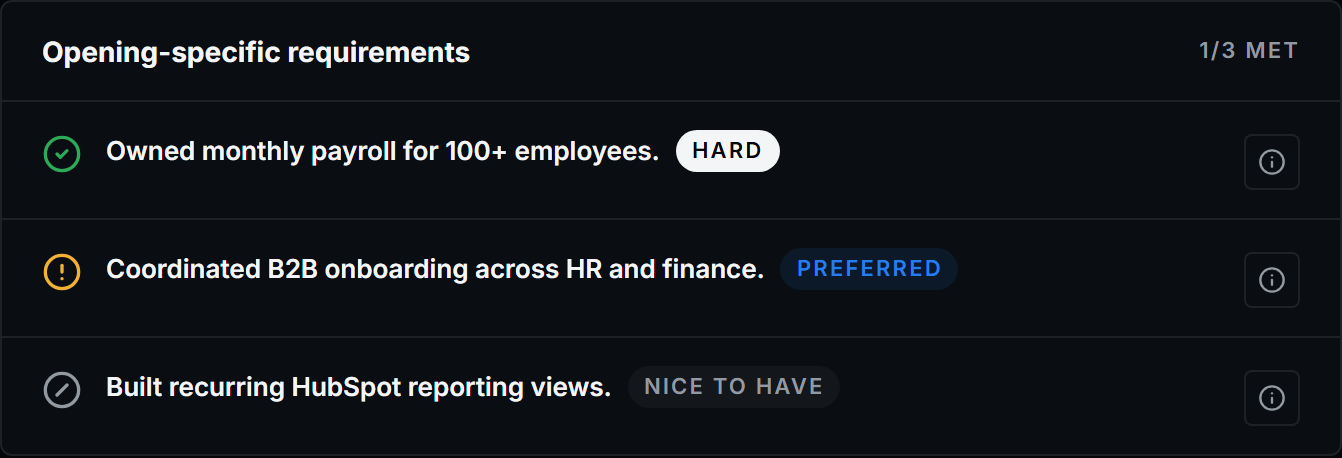
Requirement evidence before action
Requirement rows show support, partial evidence, missing evidence, and priority without turning the review into an automatic candidate decision.
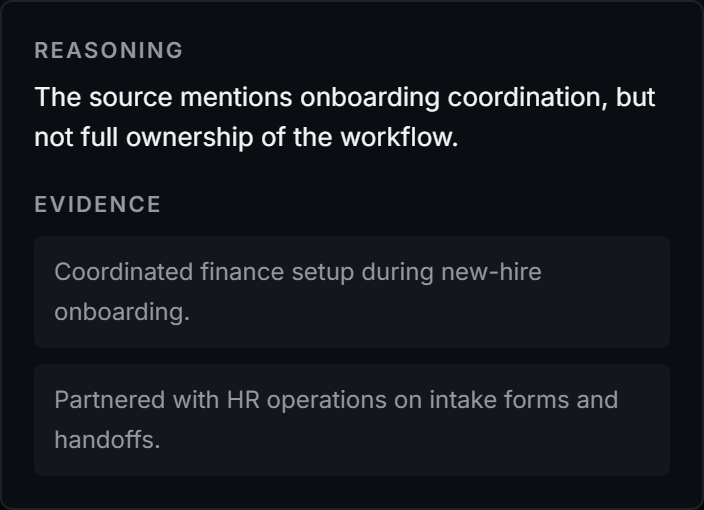
Evidence can be inspected
A reviewer can open the evidence behind a requirement, read the reasoning, and compare it with candidate-provided source excerpts.
How should missing, weak, and contradictory evidence differ?
Keep these evidence states operationally distinct:
| Evidence state | What it means | Reviewer treatment |
|---|---|---|
| Missing | The submitted material does not address the criterion | Record the gap and clarify later when the criterion matters; do not convert silence into a negative fact |
| Weak or partial | Relevant information exists but does not establish the full capability or scope | Inspect the source, record the limitation, and seek stronger evidence before relying on it |
| Contradictory | Available information conflicts across sources or clearly conflicts with the criterion | Show both sides, resolve the conflict through human review, and document the chosen interpretation |
Missing information may justify clarification. Treating it automatically as failure creates avoidable false negatives.
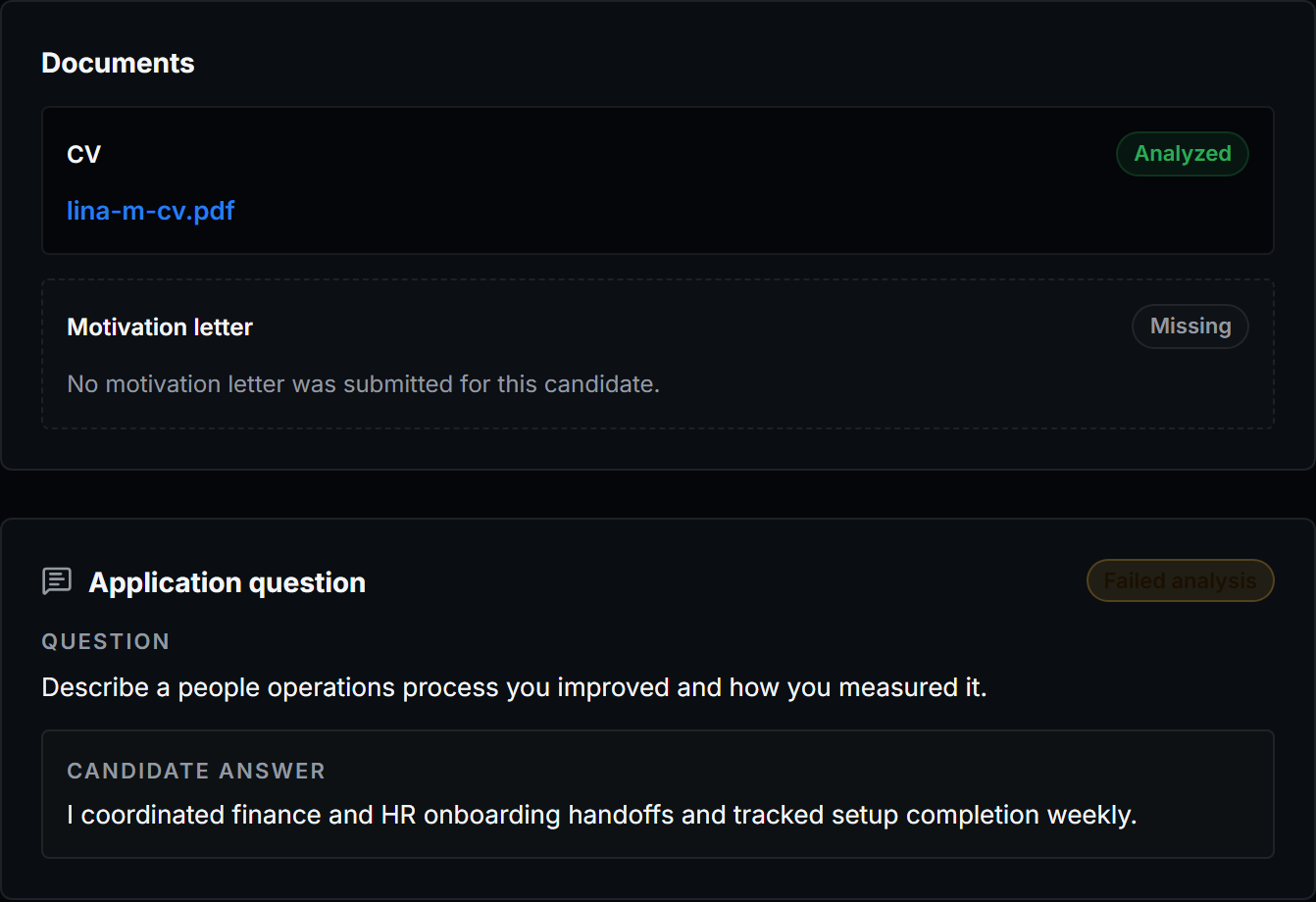
Uncertainty remains visible
Document source states show analysed, missing, and needs-review inputs so incomplete evidence is not silently converted into rejection logic.
Which actions must remain human-controlled?
Candidate progression, rejection, shortlist state, and communication should require an authenticated human action. Meaningful human control requires product behavior, not a label. The reviewer must be able to disagree with the AI-supported view and inspect enough context to do so.
Teams should also retain proportionate workflow records: which version of the criteria was used, when the analysis happened, and which human action followed. Retention should be deliberate rather than indefinite.
Status changes require a reviewer
Candidate status controls and communication blockers make progression or rejection an explicit authenticated human action.

How should a team test the workflow before use?
Run this reusable checklist with representative synthetic or approved examples before using the workflow on a live role:
- Source evidence: a strong candidate using unexpected terminology still produces inspectable source excerpts.
- Partial evidence: evidence spread across several roles remains visibly partial until a reviewer resolves it.
- Missing evidence: a CV missing a key detail produces a gap, not an invented negative fact.
- Irrelevant information: personal information outside the approved criteria does not influence the review view.
- Failure path: a parsing failure or unsupported document routes to a visible manual-review state.
- Human action: no shortlist, progression, rejection, or status change occurs without an authenticated reviewer action.
- Communication boundary: no candidate message is sent from an unreviewed model output.
Check whether the workflow exposes uncertainty and falls back to manual review instead of inventing certainty.
What are the limitations and decision boundaries?
Human review does not automatically make a system fair or lawful. A rushed reviewer can rubber-stamp outputs, and biased criteria remain biased when structured. Organisations remain responsible for their recruitment process, legal basis, information given to candidates, accommodations, and decisions.
Skilltage’s position is that AI-supported evidence should remain separate from human-selected candidate state. It is a product-design stance, not a guarantee of compliance or protection from liability.
That separation starts with explicit screening requirements and evidence expectations, can be applied to AI CV screening for manufacturing roles, and can be tested with a practical AI recruitment vendor checklist.
Next step
Map your current screening workflow and circle every point where software can change candidate status, ordering, or communication. For each point, ask what evidence the reviewer sees and what explicit human action is required.