
Why define screening criteria before opening CVs?
Define the criteria first so every reviewer applies the same job-related threshold. Recruiters are frequently asked to find someone “senior”, “commercial”, or able to “hit the ground running”. These phrases may communicate intent, but they do not tell a reviewer what evidence should count. If the criteria remain implicit, each reviewer creates a different threshold while reading applications.
CIPD guidance on selection methods favours methods that are tied to the role and applied consistently. The practical implication is simple: define the job-related evidence before comparing people.
What should a screening criterion contain?
Skilltage guidance: use four fields that connect the role need to a repeatable review action:
| Capability | Business reason | Acceptable evidence | Handling missing evidence |
|---|---|---|---|
| The work the person must be able to do | Why that capability matters in this role | CV or application information that could reasonably demonstrate it | Whether to reject, clarify later, or treat it as a preference |
“Strong stakeholder management” becomes useful only when the team describes the stakeholders, the decisions involved, and evidence that would support the claim.
Worked example: recurring-revenue customer ownership
| Capability | Business reason | Acceptable evidence | Handling missing evidence |
|---|---|---|---|
| Own recurring-revenue customer relationships after contract signature | The role must coordinate adoption, retention risks, and commercial handovers | Responsibility for onboarding, renewals, expansion, implementation outcomes, or named customer-retention work; equivalent terminology counts | Do not reject for a missing job title. Mark for clarification unless the application clearly shows the person has never owned post-sale customer work |
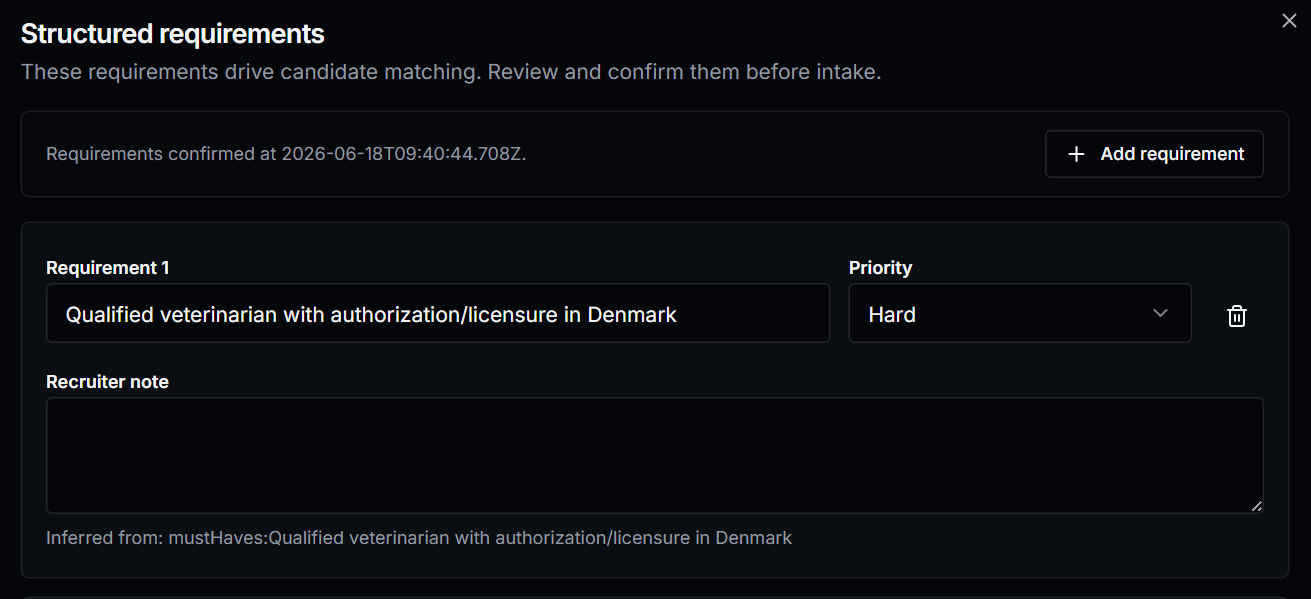
Requirement review before candidate intake
The Define step keeps requirement text, priority, recruiter notes, and the final confirmation together before candidate CVs are processed.
Which criteria are hard requirements, preferences, or trainable?
Reserve hard requirements for genuine entry conditions. These may include the legal right to work, an essential certification, a required language, or experience without which the person cannot perform the role. Preferences can help reviewers compare relevant strengths, but they should not quietly become rejection rules.
Treat trainable skills carefully. Calling every desired capability mandatory narrows the pool and makes screening less defensible.
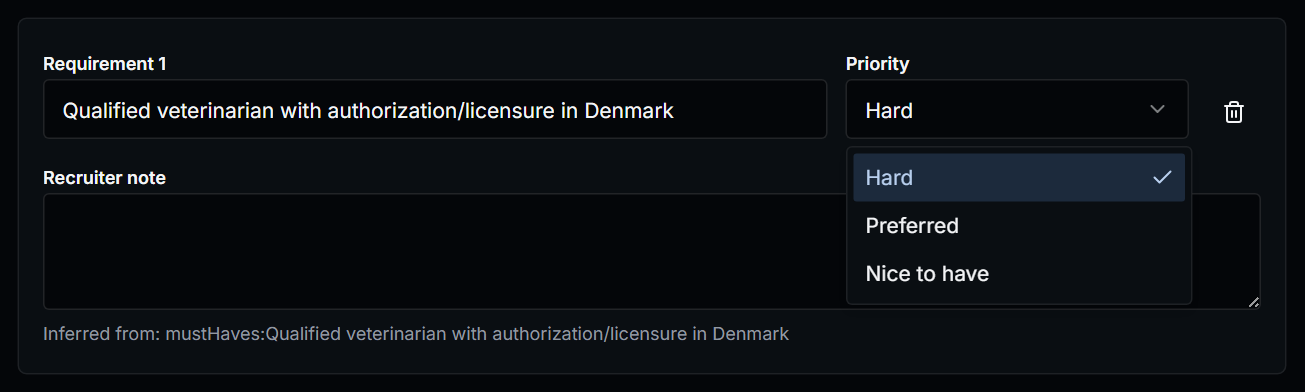
Hard, preferred, and nice-to-have stay separate
Priority labels show reviewers which criteria are entry conditions, which are normal screening criteria, and which are useful preferences.
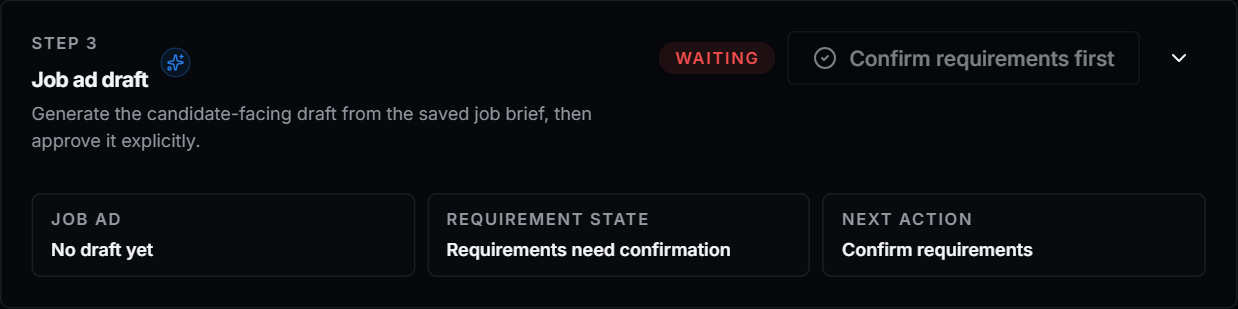
Requirement confirmation gates the next steps
The app holds the job ad draft and candidate intake until the team has reviewed and confirmed the screening basis for the opening.
What counts as acceptable evidence?
Accept evidence that demonstrates the capability, even when the candidate uses a different title, sector, or vocabulary. Keywords are weak substitutes for meaning. Write evidence expectations broadly enough to recognise equivalent experience while remaining specific enough for reviewers to apply consistently.
Example:
- Weak criterion: “SaaS experience”.
- Better criterion: “Has owned recurring-revenue customer relationships and can show responsibility for retention, expansion, or implementation outcomes.”
How should two reviewers calibrate before screening?
Use one representative sample CV and compare the two reviews before opening the live candidate pool:
- Each reviewer independently marks evidence for every criterion.
- Each reviewer records missing or ambiguous information without turning it into failure.
- The reviewers compare their treatment of the same evidence and identify disagreements.
- The team rewrites any criterion that produced different thresholds, then repeats the exercise on that criterion.
If reviewers interpret a criterion differently, improve the criterion before processing a large candidate pool. Calibration is cheaper before screening than after a shortlist is challenged.
What are the limitations and decision boundaries?
A structured requirement does not prove that a candidate can perform the job, and a CV rarely contains complete evidence. The framework supports consistent initial review; it does not replace interviews, work samples, reference checks, accommodations, or professional judgement.
Skilltage guidance is to keep missing evidence distinct from negative evidence. A CV that does not mention a capability may justify clarification, not an automatic rejection.
Continue with a hiring intake template for a review-ready job brief, then use the human-review boundary for AI-assisted CV screening and the buyer checklist for evaluating recruitment tools.
Next step
Review one live role and rewrite its five most important requirements using capability, business reason, acceptable evidence, and handling of missing evidence. If the team cannot agree on those four fields, the role is not ready for consistent screening.